IOQM Syllabus 2026: A Detailed Topic-Wise Breakdown & Weightage
Author at N SMART | October 13, 2026
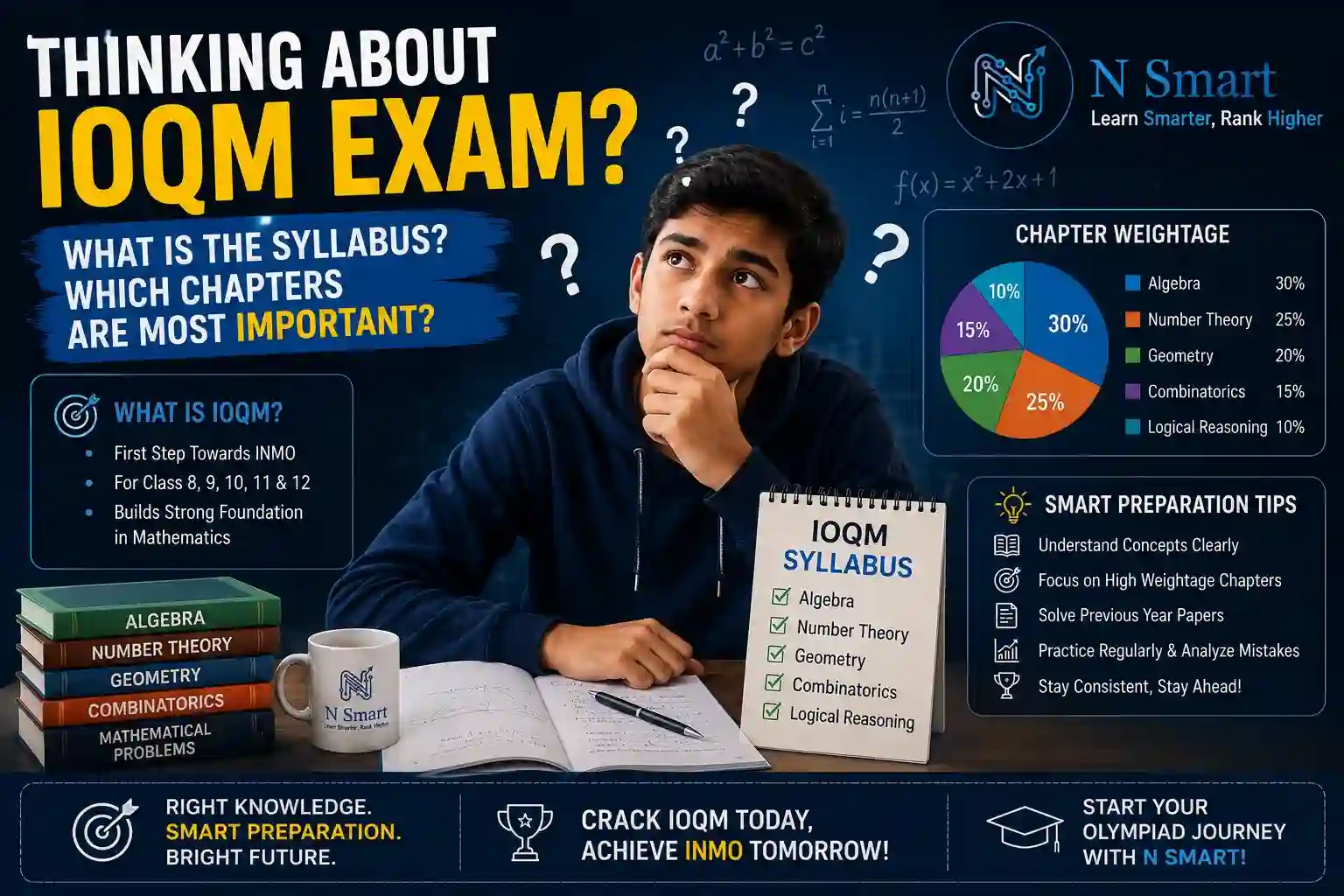
If you look up the official IOQM syllabus, you might notice the official syllabus looks deceptively simple, with mathematics from Class 8 to Class 12. While it is true that the IOQM 2026 syllabus covers pre-college maths up to Class 12, excluding calculus, the depth and the fundamental concepts go way beyond school-level maths. In this N Smart guide, we'll break down the IOQM 2026 syllabus, explain the four core topic pillars, discuss syllabus weightage based on previous years' papers, and help you understand what you should focus on.
[Note: This article is part of N Smart's IOQM Exam Guide Hub. If you're planning for IOQM 2026 or are already in the early stages of preparation, check out the guide for a clear understanding of the exam guidelines, eligibility, patterns, & a brief roadmap to IOQM success.]
IOQM Syllabus for 2026: Chapter-Wise Topics & PDF Download
The IOQM 2026 syllabus revolves around four major branches of mathematics: Number Theory, Algebra, Combinatorics, & Geometry. While there is no officially prescribed chapter-wise list, these topics consistently appear in the examination.
Tap on the blue link and download the IOQM 2026 syllabus PDF now, so you don't lose this important information when you leave this page.
Number Theory
Number theory is the foundational pillar of the IOQM paper. From 2-mark questions to the highest 5-mark questions, it appears everywhere, contributing the highest weightage out of all four pillars.
| Topics | What to Study |
| Divisibility | Divisibility algorithm, Perfect numbers, Divisor functions, Sum & count of divisors, and Properties. |
| Prime Numbers | Prime and composite numbers, Fundamental Theorem of Arithmetic, properties of factorials, and Bertrand’s Postulate (Basic). |
| GCD & LCM | Euclidean algorithm, Bezout’s identity, GCD & LCM properties, and Problem-solving applications. |
| Modular Arithmetic | Properties of congruences, linear congruences, Residue systems, & Chinese Remainder Theorem. |
| Theorems | Fermat’s Little Theorem, Euler’s theorem, & Wilson’s theorem. |
| Diophantine Equations | Linear Diophantine equations, Pythagorean triples, Equations in integers, and basic non-linear equations (Pell’s equations). |
| Arithmetic Functions | Euler’s totient function (Φ), number of divisors (σ), sum of divisors, and the Mobius function(μ). |
| Number Bases | Base conversions and operations in binary, octal, or hexadecimal systems. |
Key Insights: Prime numbers, Divisibility & Modular Arithmetic contribute the most questions. So, master these topics before moving on to other advanced topics.
Algebra
Algebra in IOQM focuses on pure logical manipulation. While school Maths & NCERT end at quadratic equations and sequences, the IOQM Algebra syllabus demands inequalities, polynomials, functional equations, and algebraic manipulation at a deeper level.
| Topics | What to Study |
| Polynomials & Polynomial Identities | Polynomial factorization, multi-variable simplifications, Vieta’s Formulas for quadratic, cubic, & higher-degree polynomials, Remainder Theorem, Factor Theorem, Rational Root Theorem, and the Fundamental Theorem of Algebra. Newton’s Identities for sum of powers of roots and Eisenstein’s Criterion. |
| Equations | Symmetric algebraic expansions, Systems of equations (linear and nonlinear), Factoring complex expressions, & Substitution techniques. |
| Inequalities | AM-GM inequality, Cauchy-Schwarz inequality, Rearrangement inequality, Jensen's inequality, and inequality-based equations. |
| Sequences & Series | Arithmetic (AP), Geometric (GP), and Harmonic (HP) Progressions, Infinite series summation, telescoping series, Arithmetico-Geometric Progressions (AGP), Linear recurrence relations, homogeneous and non-homogeneous recurrences, and mathematical induction. |
| Complex Numbers | Operations, modulus, argument, and conjugate properties. Olympiad Geometry & Algebra: De Moivre's Theorem, Euler's form, and Geometrical applications of Roots of Unity. |
| Functional Equations | Substitution methods, using symmetry, finding unknown functions under given constraints, and identifying injective/surjective properties, Cauchy’s and Jensen’s functional equations. |
| Linear Equations & Binomial Theorem | 2-variable and 3-variable equations, conditions for unique/infinite/no solutions, elementary determinants, General terms, middle terms, properties of binomial and multinomial coefficients, and combinatorial identities. |
Key Insights: Polynomials & Inequalities are the highest-weightage chapters. So, prioritise mastering these topics first.
Combinatorics
Combinatorics is one of the highest-scoring yet challenging sections of the IOQM syllabus. It examines logical thinking with discrete structures, the ability to build clever arguments, and the ability to count systematically.
| Topics | What to Study |
| Enumeration & Counting | Multiplication and addition rules, arranging objects, selecting subsets (combinations), and identities involving binomial and multinomial coefficients. |
| Probability (Basic) | Conditional probability, Geometric probability, expected value (Introductory-level) |
| Permutations and Combinations | Circular permutations, permutations with restrictions, and distributing distinct/identical objects into distinct/identical bins. |
| Pigeonhole Principle (PHP) | Basic, generalised, & extremal pigeonhole principle, number theory & geometry applications. |
| Inclusion-Exclusion Principle | Overlapping sets counting, derangement derivation & sieve methods. |
| Recurrence Relations & Induction | Defining sequences recursively, setting up & solving recurrences, and Fibonacci-type problems. |
| Elementary Graph Theory | Basic concepts such as vertices, edges, paths, cycles, trees, applying the Handshaking Lemma, and concepts of graph coloring or planarity. |
| Combinatorial Identities | Pascal’s identity, Vandermonde’s identity, & Double counting. |
Key Insights: Pigeonhole principle, Counting principle, & Permutations/Combinations are the highest-weightage chapters in Combinatorics. So, it’s better to prioritise them first.
Geometry
| Topics | What to Study |
| Triangle | Congruence, similarity, angle chasing, cevians, area, properties of special points (circumcentre, incenter, orthocentre), and Stewart’s theorem. |
| Circle | Cyclic quadrilaterals, tangents, Power of a Point theorem, radical axes, Ptolemy’s theorem. |
| Advanced Theorems | Ceva's Theorem, Menelaus' Theorem, and Mass Point Geometry. |
| Polygons & Trigonometry | Properties of cyclic/tangential quadrilaterals, sine rule, cosine rule, and trigonometric applications in proofs. |
| Coordinate Geometry | Basic locus, straight lines, circles, and an introduction to conics. |
| Geometric Transformations | Reflections, rotations, translations, and an introduction to homothety. |
| 3D Geometry | Volume & surface area of solids, Euler’s formula for polyhedra & cross-sections. |
Key Insights: Triangles & Circles are the top priority in the Geometry topic. Master these fundamentals before advancing to topics like inversion.
IOQM Syllabus Weightage (2020-2025 Analysis)
N Smart IOQM expert teachers have analysed the previous 5 years' question papers and noticed a trend where most questions are derived from. So, here’s the exact table of topic weightage for IOQM:
| Topics | Approx. Weightage |
| Number Theory | 30-35% |
| Combinatorics | 25-30% |
| Geometry | 20-25% |
| Algebra | 20-25% |
Key Insights:
- Number Theory and Combinatorics together contribute nearly 60% of the highest-mark (5-mark) questions.
- Geometry appears across all three sections consistently.
- Algebra is spread evenly throughout the paper.
[Note: The chapter-weightage analysis has been done by N Smart, analysing IOQM question papers from 2020-2025 to give you an idea of which chapters to focus more on. However, unlike school board examinations, these topics are never tested in isolation. Questions always test conceptual understanding, requiring knowledge from multiple topics together (E.g., Number Theory & Geometry combined).]
Final Thoughts
The IOQM syllabus may look concise compared to other competitive exams, but its depth is what makes it one of the most challenging examinations in India. Whether you're searching for the IOQM syllabus for Class 8 or Class 10, the syllabus remains the same. Only the depth of preparation changes depending on the class.
Frequently Asked Questions
Which topics are the most important for the IOQM exam?
Number Theory, Algebra, Geometry, and Combinatorics are the major focus areas for the IOQM exam, focusing on fundamental concepts to advanced problem-solving techniques.
Is the IOQM syllabus based on the NCERT curriculum?
The core chapters of the IOQM syllabus are based on the NCERT textbooks. However, the depth & the application method are completely different than what is taught in school mathematics.
Where can I get the IOQM Syllabus 2026?
You can get the full, accurate syllabus for IOQM 2026 here on the N Smart blog.
What is the syllabus of IOQM 2026?
The IOQM 2026 syllabus includes Number Theory, Geometry, Algebra, and Combinatorics from Classes 8 to 12, excluding calculus.
Is calculus present in the IOQM Exam 2026?
No. Although the official IOQM syllabus follows the NCERT textbooks from Class 8 to 12, chapters like calculus, matrices, determinants, & statistics are not included.
Is the IOQM syllabus the same for all the classes?
Yes. The syllabus for IOQM is the same for all the classes. However, the preparation depth differs depending on the class, and so does the cut-off.