How to Study Physics for JEE from Zero Level?
Author at N SMART | October 13, 2026
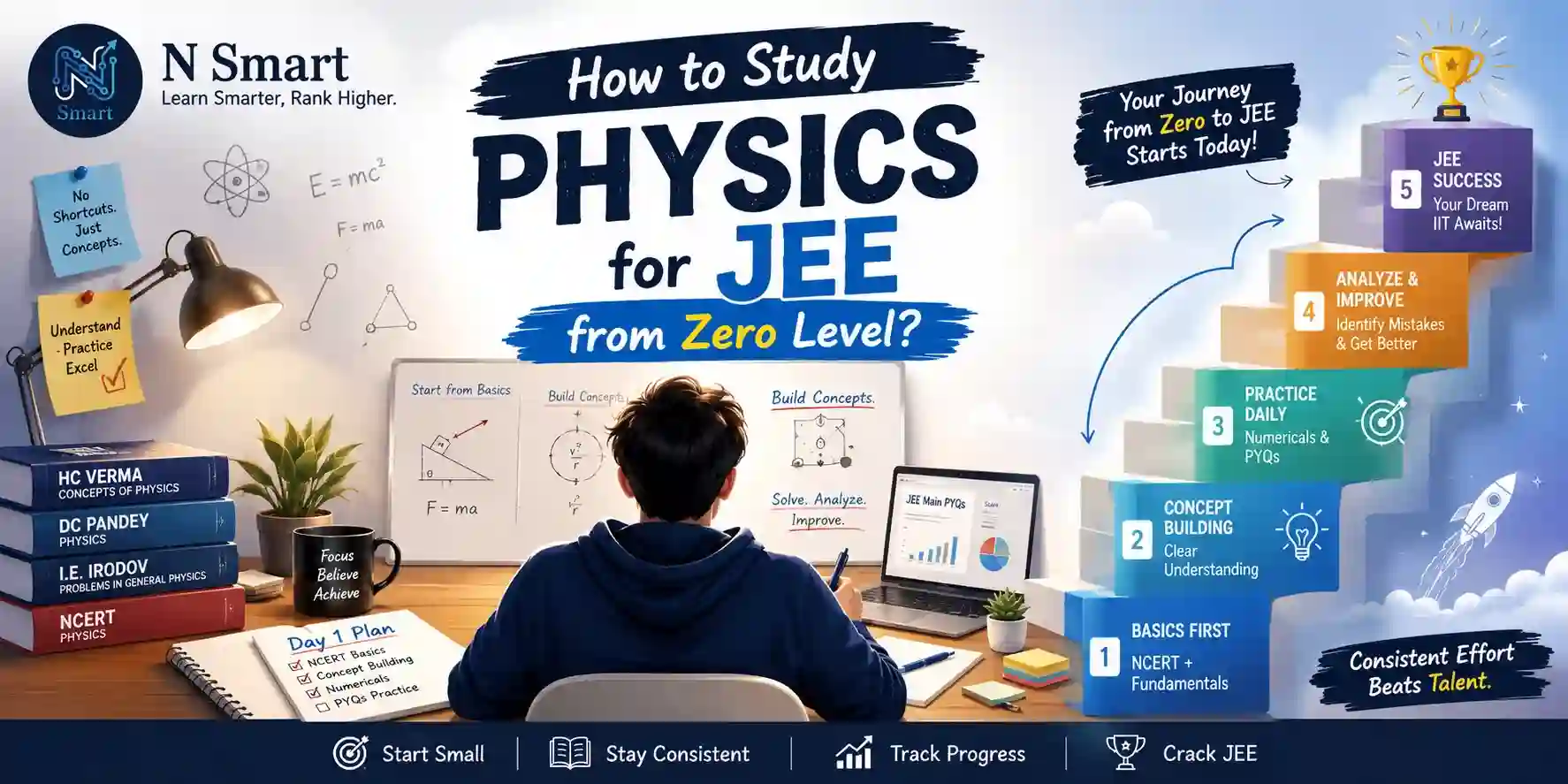
Physics is one of the most important subjects in JEE, yet most students fear it. Often, students find solving numericals or vectors the most challenging, and it breaks their confidence. However, JEE Physics can be the most fun subject if you study it and learn it the right way.
Physics, especially in JEE, demands your ability to identify which concepts to use and how different concepts are connected. That’s why you need to focus on conceptual learning over memorisation, visualise problems, and solve them logically & regularly. So, in this JEE Physics Preparation guide, we will share how to approach the subject the right way, which topics to prioritise more, how to practise problems, along with a few tricks to master the subject for JEE 2027.
[Note: This article is a part of our complete preparation hub. If you're new to JEE, check out our JEE Preparation Strategy to learn how to crack the exam next year.]
Before Physics, Fix Your Math First
Maths is the foundation of Physics. If you have a weak mathematical foundation, you will have a hard time trying to solve Physics problems. So, before you jump into studying Physics, spend one week repairing your mathematical foundation. Focus on:
- Vectors
- Differentiation
- Integration
- Maxima & Minima
- Graphs
- Basic Trigonometry
- Basic Calculus
If you build a meaningful base of these mathematical concepts, studying Physics for JEE will be much easier.
JEE Main Physics Chapter Weightage: Previous Papers Trend
There is no chapter-wise weightage officially released by NTA. However, N Smart experts have analysed the previous years’ question papers and prepared a solid chapter-wise weightage along with the number of questions that you can refer to while preparing for JEE Physics.
| Chapters | No. of Questions in 2026 | Approx. Weightage |
| Optics | 56 | 11.79% |
| Electrostatics | 39 | 8.21% |
| Properties of Solids & Liquids | 39 | 8.21% |
| Rotational Motion | 26 | 5.47% |
| Electromagnetic Induction & AC | 25 | 5.26% |
| Current Electricity | 24 | 5.05% |
| Oscillations & Waves | 24 | 5.05% |
| Atoms & Nuclei | 24 | 5.05% |
| Magnetic Effects & Magnetism | 29 | 6.11% |
| Physics & Measurement | 23 | 4.84% |
How to Study Physics for JEE Main: Complete Step-by-Step Guide
Step 1: Concepts & Foundational Learning
To master Physics for JEE, you need to build a strong foundation. Start with understanding the theoretical concepts, the basic definitions, principles, and laws. Ask yourself why “this phenomenon” happens and where you can apply this same “concept”. Your goal should be to explain the concepts to your younger brother or sister. If they understand what you meant, you truly understand the concept.
Step 2: Learn Formulas Before Memorising
Instead of memorising every formula, understand the core concepts & where each formula comes from. Understand what each variable represents, how they are related, and under what conditions the formula works.
Step 3: Practice Questions
After understanding a formula or a concept, immediately test your theory with a simple question and see if you can apply the concept correctly. Then, level up your practice by taking up by increasing question difficulty and practising questions with different situations.
Step 4: Solve Advanced Problems
Once you build strong fundamentals, practise different questions and attempt advanced JEE-level Physics problems that require you to apply knowledge from multiple concepts.
Step 5: Analyse Your Mistakes
If you can’t solve a problem or get a wrong answer, analyse where you went wrong in your attempt. Was it a conceptual gap? A calculation error? Or simply couldn’t recall a formula? Understanding this error makes it much easier for you to improve your Physics problem-solving skills.
JEE Physics Strategy: How to Tackle Every Physics Chapter
| Chapters | Strategy |
| Mechanics | Master free-body diagrams and constraint relations first. Use conservation laws (energy, momentum, angular momentum) whenever forces get messy. Rotation (torque, rolling, angular momentum) is the biggest Advanced differentiator, so give it extra time. Gravitation and fluids are formula-driven and quick for Main. |
| Thermodynamics & Heat | Fix one sign convention. Turn every P-V graph into named processes and read work as area. Cover KTG (degrees of freedom, Cp/Cv, speeds), calorimetry, and heat-transfer standard results. |
| Waves & Sound | Standing waves in strings and pipes, beats, and Doppler (all source/observer/medium cases) cover most questions. Practise wave-equation and graph-based problems. |
| Oscillations | Derive the time period from the restoring force each time, and use energy methods. Know spring combinations and pendulum variants, then practise blending them with rotation and fluids. |
| Electrostatics | Gauss's law with symmetry, potential and energy, induced charges on conductors, and capacitors (networks, dielectrics, battery connected vs disconnected). |
| Current Electricity | Simplify circuits using symmetry and equipotential points, and know Kirchhoff's laws. For RC transients, an uncharged capacitor acts like a wire at t = 0 and a break at t → ∞. Also cover the meter bridge and potentiometer. |
| Magnetism | Charged-particle motion in B and E+B fields, Biot-Savart standard results, Ampère's law with symmetry, and torque on loops. Read magnetic materials from NCERT for Main. |
| EMI & AC | Think in terms of flux change. Motional-EMF problems are mechanics plus energy conservation, so practise them alongside Mechanics. Use phasors for LCR, resonance and power factor. |
| Optics | Fix a sign convention, draw ray diagrams before using formulas, and handle lens/mirror combinations one surface at a time. Wave optics is small and formula-driven, so finish it first. |
| Modern Physics | Photoelectric effect (including graphs), Bohr model, radioactivity and binding energy, X-rays, and semiconductors/logic gates for Main. Use NCERT line by line plus PYQs. It takes about 10-12 days, and you should revise it weekly because it's easy to forget. |
| Experimental Physics | Least count and zero error, error propagation, graph slope/intercept, and the standard experiments (pendulum, Searle's, meter bridge, potentiometer, lens focal length, resonance tube). Fold these into the related chapters rather than studying them as a block. |
JEE Physics Preparation Tips
Read-Visualize-Solve Framework
Suppose you are studying Mechanics. Start with conceptual theory. Draw the situation as a free-body diagram whenever it’s appropriate. Then, solve questions by applying the formulas & equations.
Choose the Right Study Materials
In terms of study materials, there is no shortage of both online and offline options. But you have to choose the right ones for your JEE Physics preparation that clarify concepts and give enough questions from basic to advanced levels to practise.
➡ Check out the best books for JEE Physics preparation.
Practise Problems Regularly
To master JEE Physics, you have to practise new problems daily, especially numericals. Solve NCERT problems, practise examples, and then move on to objective books to keep your daily practice intact.
Prioritise High-Weightage Topics
Refer to our previous chapter-wise weightage table for JEE Physics and prioritise high-weightage topics. Since these chapters carry more questions in the exam, it's best to spend more time on them.
Final Verdict
The effective way of preparing for JEE Physics is to focus on clarity, conceptual depth, daily practice of problems, and repeated revisions. Mastering Physics for JEE is all about understanding the theories and applying them in application-based problems, rather than trying to memorise everything. Follow this cycle:
Understand Concepts → Visualise Theory → Apply Knowledge to Problems → Analyse Your Mistakes → Revise Concepts.
Frequently Asked Questions
How to study Physics for JEE Main?
Start with basic concepts and practise regular problems. Keep a notebook for short notes and prioritise PYQs and mock tests.
How many hours should I study Physics for the JEE Main?
Since you have other subjects to prepare for too in JEE Main, you should dedicate at least 2 to 3 hours to Physics daily, depending on your total study hours. These 2 to 3 hour session includes learning concepts, practising numericals, and revising old topics.
What are some high-weightage topics in JEE Physics?
Thermodynamics, Current Electricity, Modern Physics, Waves & Optics, Electrostatics, and Laws of Motion are the highest-weightage topics in JEE Physics 2027.
How to revise Physics for JEE 2027?
For the best outcome in JEE 2027, revise Physics formulas daily and use an error book that contains all of your mocks and PYQ analysis, and revise the topics in which you made the most mistakes in mocks or PYQs. Along with that, integrate a small weekly and a grand monthly revision as well, especially when you’re still in your building conceptual base stage.