Self-Study vs. Coaching for JEE: Discover the Pros & Cons of Both Approaches
Author at N SMART | September 23, 2026
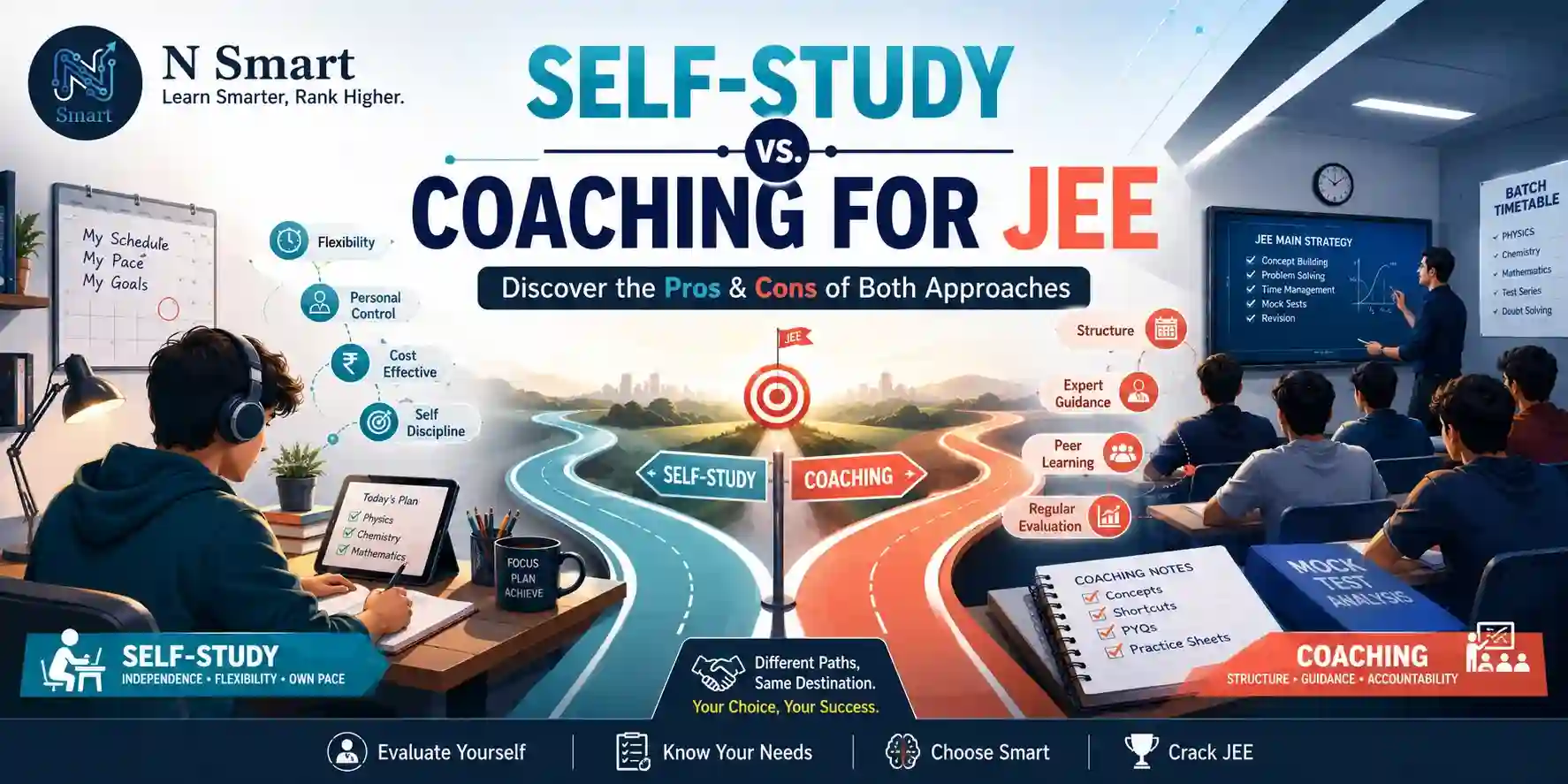
Preparing for JEE Main is undoubtedly a rigorous journey that requires constant discipline & consistency. However, students often feel confused about the preparation approach: self-study or coaching – which is better for JEE preparation.
To give you a brief, honest answer, neither approach is inherently better than the other. Some students prefer self-study for the flexibility, while others prefer structured JEE coaching because they lack confidence, need guidance, and need accountability. The ultimate choice depends on your learning style, dedication, self-discipline, time management, and the need for external support & guidance.
In this article, we are going to share the pros and cons of both approaches, so you can decide which one is actually best for you in JEE: self-study or coaching.
[Note: No matter what approach you follow for JEE, the real truth is you still need to follow a structured JEE preparation strategy.]
Benefits of Self-Study for JEE
The advantages of self-studying for JEE over coaching are as follows:
- Time Flexibility: The biggest advantage of JEE selff-study is that you have a flexible schedule and you can have your study sessions as you will.
- Cost Effectiveness: Self-study is way more cost-effective compared to JEE coaching, be it online or offline. You don’t need to pay coaching fees, transportation costs, or any other hidden fees that come along with this.
- Self-Discipline: When you prepare for JEE through absolute dedicated self-study, you build a form of self-discipline that carries on to your engineering college days as well.
Disadvantages of Self-Study for JEE
- Procrastination: The biggest disadvantage of studying on your own for JEE is procrastination. It can stem from a lack of guidance, accountability, or motivation, which can lead to a failed JEE year.
- Aimless Studies: Without proper guidance or mentorship, students often find themselves lost in preparation, studying random topics with no structured plan, which leads to poor performance in mock tests and PYQs.
- Conceptual Gaps: While self-studying for JEE, sometimes students need external help to clear doubts, and sometimes they can’t even clear them if their external source is a YouTube video or a reference book. In that case, a deep conceptual gap remains, which compounds over time, making the foundation weak.
- Lack of Competitive Exposure: When you study alone, you miss the opportunity to compare your marks with your batchmates, lacking the competitive exposure needed for JEE preparation.
- Delay in Doubt Resolution: Another big disadvantage of self-studying for JEE is that when you get stuck on a difficult problem, you spend hours trying to unwind the problem with the help of the internet or a reference book.
- Resources Overload: Self-study students often believe that having or studying from multiple sources (reference books, videos, crash courses) can boost their preparation. In reality, this hampers their preparation with cluttered sources.
Advantages of a Structured JEE Coaching
- Expert Faculty: The biggest advantage of joining a coaching centre for JEE, be it online or offline, is the direct access to expert faculty. You study under an experienced mentor’s guidance who can give you personalised study plans and guide you through any hurdles you might encounter.
- Structured Curriculum: Having a structured curriculum in JEE coaching like N Smart can help students align with their target goals while making sure no conceptual gaps remain.
- Peer Competition: Studying in a structured JEE coaching environment surrounds you with students with high motivation, which indirectly improves your dedication, performance, and improves your ranks.
- Doubt Resolution: When you’re enrolled in a JEE coaching program, mentors help you solve your doubts immediately, leaving no room for conceptual gaps.
Disadvantages of JEE Coaching
- Financial Burden: Most JEE coaching programs are not affordable at all. Although some online platforms offer affordable options, their credibility comes into question. Even if you get affordable coaching for your preparation, it will still be costlier than studying on your own.
- Rigid Timing: There is no flexibility in terms of timings. You have to follow a rigid schedule and follow the coaching’s timings.
- Lack of Self-Practice: Often students either depend completely on the coaching’s teachings, or they don’t get enough time after school and coaching to study on their own.
- High Number of Students: Coaching centres stay filled with students where good students always get prioritised, and average students get overlooked, creating a huge conceptual gap.
A Complete Comparison Table: Self-Study or JEE Coaching – Which is Better?
The answer depends heavily on your learning style, discipline, budget, and ability to access reliable resources.
| Factor | Self-Study | JEE Coaching |
| Pace of Learning | Fully customized to your speed | You generally follow the batch pace |
| Financial Cost | Potentially under ₹5,000 for books, PYQs, and tests | Often ₹1,00,000 to ₹3,00,000+ per year, depending on institute and location |
| Time Efficiency | No daily commute | Travel can consume significant time and energy |
| Doubt Resolution | Requires independent use of books and online resources | Faculty support is available within the institute |
| Discipline & Routine | Requires strong self-discipline | Schedule and tests create external structure |
| Competition | Must be created through test series and online platforms | Built into the classroom environment |
| Flexibility | Very high | Limited by batch schedules |
| Personalisation | Extremely high | Depends on batch size and faculty attention |
Final Verdict: Which One Is Better for You?
Instead of asking, “Is self-study better than coaching for JEE?”, analyse your preparation style. Ask yourself if you are comfortable finding solutions to doubts, analysing your own mistakes, completing chapters independently, and taking tests without external pressure. If you answered yes to all of that, self-study for JEE preparation is definitely for you.
On the other hand, if you regularly postpone chapters, skip tests, struggle to maintain a routine, or keep switching between resources, a structured JEE coaching environment may solve your problems, and you should definitely opt for coaching.
Next Steps for Your JEE Preparation
Once you have decided how you want to study, stick to that plan. If you plan on studying on your own, your next job is to figure out the best books for JEE preparation and prioritise finishing high-quality materials first.
Then create a realistic study plan for JEE Mains that converts your goals into daily and weekly actions.
Frequently Asked Questions
Is it possible to crack JEE without coaching?
Yes. Many students have previously cracked JEE through NCERT reading, online crash courses, practising mocks, and targeted revisions. The key is to follow a reliable, structured preparation strategy consistently that prioritises regular practice, mock analysis, and revision.
Is coaching necessary for JEE?
No. Coaching is not strictly necessary to understand the concepts required for JEE. Every major concept in Physics, Chemistry, and Mathematics can be learnt through textbooks, lectures, problem sets, previous-year questions, and online resources. However, coaching provides an environment of a fixed academic schedule, regular testing, peer competition, and faculty support, which helps students stay disciplined throughout the preparation.