How to Balance Class 12 Boards and JEE Main: Effective Strategies & Tips
Author at N SMART | October 12, 2026
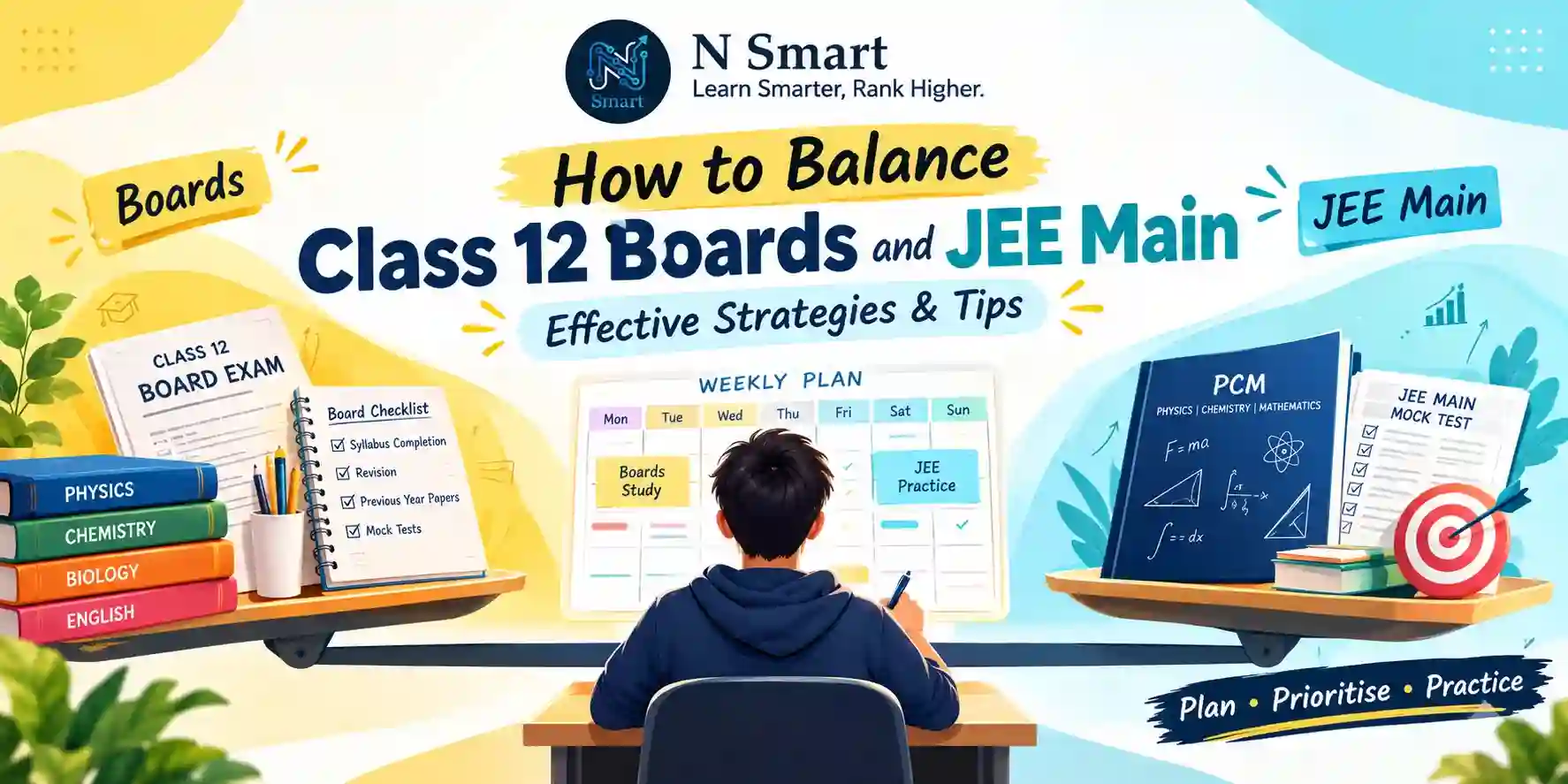
Studying for JEE is already a challenging task for most students, and then adding the Class 12 boards on top of that? We understand how daunting & scary it may feel just thinking about how to balance Class 12 boards & JEE together. Honestly, there is no secret answer to that question.
The two goals: scoring good marks in CBSE boards and achieving a top JEE AIR share a lot of similarities in terms of actions, milestones, & syllabus. The remaining small differences are not that hard to manage, especially if you have a strong base. But students often make the mistake of chasing one goal (JEE) so hard that they ignore the second one (Class 12 boards) completely.
In this N Smart article, we are going to discuss the strategies and plans on how you can balance the Class 12 boards & JEE simultaneously for 2027, including the syllabus overlap, the study hours, and the revision strategy.
Understand the Differences Between Class 12 Boards & JEE
Before we jump into the strategies, it’s important for you to understand the differences very well: what each exam demands from you and where the separation line lies.
- Class 12 boards demand understanding subjects & concepts, memorising formulas, and presenting them in exams, while JEE demands in-depth understanding of concepts and the skill to solve advanced problems under time pressure.
- Class 12 board exams require proper format, recall of definitions, & long-form written answers, while JEE requires understanding of application-based questions, analytical thinking, and excellent time management skills.
Syllabus Overlap Between JEE & Class 12 Boards
If you consider the structure of your study topics like a pyramid, at the base you'd find the NCERT topics & broad theoretical concepts that work for both your Class 12 board and JEE. JEE-level preparation, advanced topics & problem-solving come on top of that base. All the three subjects, i.e., Physics, Chemistry, and Mathematics the foundational concepts overlap significantly. Here’s what is exactly common between both exams and what addition is there:
| Subject | Most Common Topics | Additional for JEE |
| Physics | Electrostatics, Current Electricity, Magnetism, Optics | Advanced numericals & multi-concept problems |
| Chemistry | Solutions, Electrochemistry, Chemical Kinetics, Organic, Coordination | Detailed Inorganic facts & in-depth understanding of mechanisms |
| Mathematics | Calculus, Vectors, 3D Geometry, Probability, Matrices | Advanced application, mixed-topic problems, time management |
Insights: So, for example, studying Electrostatics or Solutions once for Class 12 & then doing it again for JEE is an absolute waste of time. Treat your board preparation, especially for NCERT, as the foundation of your JEE preparation.
How to Prepare for Class 12 Boards & JEE Together?
Build the Conceptual Base
In the beginning, do not segregate your preparation for boards or JEE; study NCERT textbooks and class notes as if you need to build a strong conceptual foundation anyhow. Read every chapter carefully and ensure that you understand every definition, formula, concept, reaction, diagram, and derivation.
- For Physics, practise important derivations and understand where each equation comes from.
- For Chemistry, pay attention to NCERT-based theory, reactions, exceptions, mechanisms, and factual details.
- For Mathematics, focus on formulas, concepts, methods, and worked examples.
At this stage, your goal is to build a strong, broad foundation that works as the base for your JEE Main as well.
Take Your Preparation to the JEE Level
Once you build the conceptual foundation, move to JEE resources. For example, use H.C. Verma for Physics for additional & JEE-level conceptual & objective practice. The topics of objective questions or problems remain the same, while the difficulty and the steps increase.
Solve PYQs for Both Exams
Once you’re done with finishing all the chapters from NCERT & one other secondary reference book, start solving previous years’ question papers to test your conceptual understanding and preparation. Target at least 30 JEE Main PYQs and at least 5-10 Board PYQs under exam-standard time constraints.
The JEE PYQs test whether you can apply the concept under extreme time pressure, while the Class 12 Board PYQs test whether you can present that same concept in the long-subjective format.
Balancing Class 12 Boards & JEE: Month-Wise Timeline
Students often start panicking about Boards in December when they haven’t touched a single subjective answer throughout the year. To avoid that, build a structured plan early that prioritises both exams accordingly:
| Timeline | Focus Area | Focus Ratio (Boards:JEE) |
| April to September | Focus on building a conceptual base & practising advanced problems | 20:80 |
| October to December | Keep up the JEE preparation; Add broad, subjective answer practice | 35:65 |
| January to February | Focus more on subjective writing, PYQs, diagrams, & revisions | 70:30 |
| During Exam | Only board exam-centric revision & practice | 100:0 |
| March to April | Complete JEE-focused: mocks, analysis, & revision | 0:100 |
Insights: Do not shut off any preparation completely; the only exception is the exam window (15-20 days).
Quick Tips to Balance Boards & JEE
- Prioritise the common topics/chapters that have high weightage in both exams.
- Build a weekly study schedule, allocating dedicated time for subjective writing practice and objective preparation.
- Solve previous years’ papers and mock tests diligently for both exams to improve time management and accuracy.
Last Few Weeks Strategy to Manage JEE & Boards Together
The last two months are the most difficult for most Class 12 students. Often, they either drop JEE practice completely or don’t focus enough on Class 12 board answer presentation, and they end up in a dire situation.
- Do not stop JEE-centric practice or preparation completely. Keep at least 1 hour dedicated to JEE daily and rotate the subjects every day to give them equal priority.
- Focus more on answer presentation: step-wise math solutions, diagrams, and broad answers that bring full marks in boards.
- Solve previous year’s Class 12 board question papers under the exact time constraints, analyse your mistakes, and revise the weak areas.
- Fully dedicated to JEE after your board exam is completed for the April session.
Why Class 12 Board Is Important: The 75% Criteria
Many students have this misconception that achieving a top JEE rank is enough to get into a prestigious engineering college, and they just have to pass the board exam somehow. However, for most IITs & NITs counselling, the board result works as an eligibility criterion that they need to qualify even before the topic of ranks comes up.
For all General, OBC, & EWS candidates, 75% marks in Class 12 boards or top 20 percentile in the respective board is an absolute mandate, while the eligibility criteria for SC/ST candidates fall at 65% in Class 12 or be in the 20th percentile in the board.
So, you can not take board preparation lightly at all if your goal is to get into an engineering college. Class 12 board is equally important as JEE, if not more.
Next Steps in Your Preparation
Once you understand how to balance both Class 12 boards & JEE, the next step is to build a structured routine and integrate the balance into your broader JEE preparation strategy so that every month has a clear academic priority.
You should also check out how to fit school hours into your daily JEE timetables, so your study plan remains realistic rather than becoming another schedule you cannot follow.